



At Floron, a formula is only approved if it has been standardised, accurately measured, tested — and reviewed by healthcare professionals. This is how we work.
Assembled in Switzerland
Certified laboratory
GMP standard
Good Manufacturing Practice
Analysed in the laboratory
Independent third-party testing
Vegan & additive-free
GM-free and gluten-free
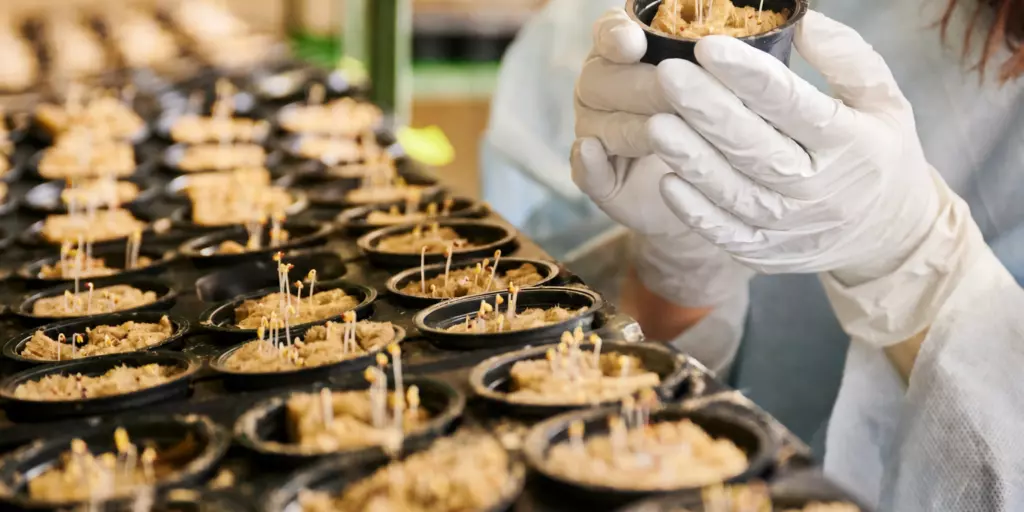
Our method is based on four requirements, which are applied to every formula.
A guaranteed active ingredient content, batch after batch — not just a mushroom powder.
Each active ingredient is formulated at an appropriate level, and the exact quantity is specified.
Each batch is tested by an independent laboratory, in addition to our own checks.
A committee of healthcare professionals reviews the formulations and claims.
Floron compared with a conventional mushroom supplement
Criterion | Floron | Traditional market |
|---|---|---|
Standardised extract (guaranteed content) | Yes | Often powder |
Active ingredient concentrations shown | Yes | Opaque complex |
Analysis by a third-party laboratory | Each batch | Rare |
Certificate of Analysis by batch number | Yes | Rare |
Manufactured in Switzerland (GMP standard) | Yes | Unclear origin |
Our products are reviewed by an independent committee, which brings together the expertise essential to a reputable supplement.
Medical adviser
Checks the suitability and safety of the formulations, and ensures the accuracy of each health claim.
Pharmacist
Monitors product dosages, potential interactions and regulatory compliance.
Mycotherapist
Provides expertise on mushroom strains, their active compounds and their documented uses.
Quality Manager
Ensures that checks are carried out, traceability is maintained and a certificate of analysis is issued for each batch.
An honest overview: these are avenues that have been explored in research,
presented without any therapeutic claims.
The research focuses on hericenones and erinacines, two families of compounds specific to this strain, and their possible role in concentration and working memory. A systematic review and a controlled trial published in 2025 report encouraging findings, albeit based on small sample sizes. Research into the nerve growth factor, meanwhile, remains at the preclinical stage. We are monitoring these findings closely and presenting them without over-interpretation.
Reishi is being studied for its triterpenes and polysaccharides, and for their possible interaction with the physiological stress axis. It is also the strain for which our literature is most limited: few clinical trials, small sample sizes, and heterogeneous protocols. We prefer to state this rather than fill this gap with references that do not exist. What we guarantee here is the quality of the extract — 100 % fruiting body, standardised to 35.7 % of beta-glucans — not any particular effect.
This is the best-documented strain in our range in terms of exercise performance. A review published in 2025 in *Nutrients* brings together five intervention studies involving a total of 321 participants, whilst a meta-analysis published in the same year examines variations in ventilatory threshold and VO₂peak. A crossover trial published in *PLOS ONE* explores oxygen saturation at rest. The sample sizes remain modest: these are avenues for further research, not definitive conclusions.
Hydrolysed collagen peptides are backed by the most extensive body of clinical evidence on this page. A meta-analysis of 23 controlled trials published in 2025 in the American Journal of Medicine examined skin hydration and elasticity; another focused on knee joint mobility. The treatment regimens studied ranged from 2.5 to 10 g per day over eight to twelve weeks — one serving of FLORON provides 10 g. A safety review published in 2026 found no serious adverse effects.
References to the studies cited will be made available and regularly updated by our committee.
Discover the formulations from our Swiss laboratory – traceable, precisely measured and tested, batch by batch.